Social Media usage in Germany

Social media has long been an integral part of everyday life. Social media have developed into imposing networks that are no longer just dedicated to communicating with acquaintances. The distribution of content via the channels of social media has become a driving force in business, politics and society.


The high degree of networking, the generally endless availability of potential customers and the improved possibility of comprehensive brand presence have made social media the most interesting and promising medium for advertising and image campaigns. Anyone who wants to be successful today must not shy away from the possibilities of social media.


 Below you will find out why.

 Social media in facts and figures


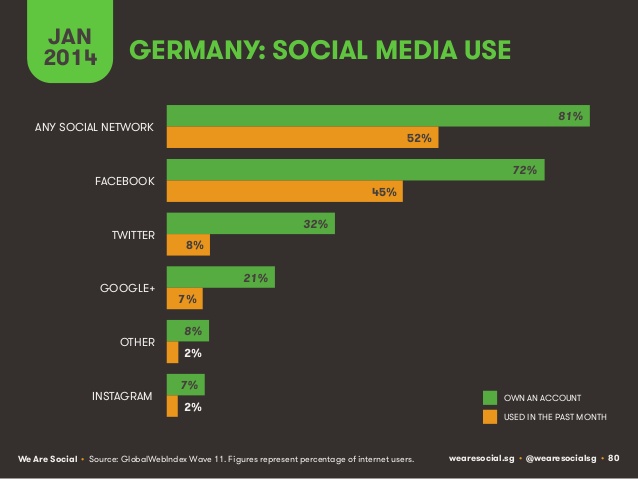
A large part of the German population has a profile with at least one provider of social media. A study by the public broadcaster ARD and ZDF comes to the conclusion that in 2016 83.3 percent of the German population take online services. That’s 58 million people in numbers and almost 24 percent more than 10 years ago. The majority of daily use, according to the study, is accounted for by the group of 14-39 year-olds, while in people over the age of 60, only 35.9 percent are online daily. However, the trend is increasing among all age groups.


According to the statista website, about 30 million people are registered on Facebook in Germany, while the Instagram service has around 15 million German users. Statista also claims an overwhelming number of nearly 2.2 billion monthly Facebook users in January 2018. This means that almost one-third of the world’s population accesses the services of the social network at least once.


Whatsapp and Facebook still great, Instagram and Snapchat catching up The study by ARD and ZDF comes to a percentage of 58 percent for Whatsapp and 34 percent for Facebook (weekly use).


 More than half of all people in Germany communicate via Whatsapp at least once a week. Teenagers, on the other hand, are enthusiastic about the Instagram and Snapchat services. Among the 14-19 year olds, the two younger services are close to the Facebook Facebook. Instagram has even overtaken Facebook (50 percent) with a weekly usage of 51 percent, while Snapchat already comes to 43 percent.


According to the study by ARD and ZDF internet users spend on average 2 hours and 29 minutes for online activities. Men use the internet for longer than women. Basically, the time spent on the Internet is steadily increasing. For the 14-19 year olds, the value is even 4 hours and 30 minutes. Again, the older the consumer, the less time he spends a day on the Internet.


forecast 


While many studies do not expect a significant increase in user numbers over the next few years, the importance of social media will increase. It is obvious that the useful life and intensity will continue to increase strongly in the coming years. The developments of recent years show a steady increase in activity on social media such as Facebook, Instagram, Snapchat and Co. The expected relatively small increase in user numbers can also be explained by the already widespread reach of social media. The exponential growth of the last decade is missing, but there is a compression and intensification of use.

Accordingly, the media agency Zenith predicts an increase in social media spend of 72 percent between 2016 and 2019. This would account for 20 percent of Internet advertising, at 16 percent today. It is even assumed that advertising through social media by 2020 will have overtaken advertisements via newspapers. Advertising via social media will most likely become an indispensable part of marketing.


Techtificator Observation -:
                                                                         In short Social media is now our basic need.

Make money on Instagram using bots on your account

When we think about pics and video uploading we first think about Instagram because it becomes more popular.We all must have also heard about the bots on Instagram which are speculated to be used to be humans as well. It is difficult to differentiate between bots and humans on Instagram. Which gives rise to a new wave of users who are giving over their accounts to the bots, in a hope that #food-porn and #pets images receive more number of views.

The process works something like this: Users contact Fuel Gram and pay for bots so that it can send it to the bot army to specific posts like Facebook boosting process. This will allow thee posts to get a greater reach, essentially gaming the Instagram algorithm so that it hits the top of the Explore section.

Even though Instagram has been claiming that such services generate fake like which are against its terms of services, and as per some sources they are continuing their operation.

“Fraudulent activity is bad for everyone. We have a strong incentive to prevent this kind of behaviour on Instagram and staff a number of teams to detect fraudulent activity and shut it down”, as per some reports from Buzzfeed. Most of the usage related cases mostly included the influencers getting extra likes and comments on a branded or sponsored post or even a video, which might appear as a viral post to the ordinary users.


Further as per BuzzFeed, it had bought Fuelgram’s service for the investigation related to a spin-off an account name “Viral Hippo” and it was easily able to get nearly 1,500 like on the dull posts like the above yellow square, another green square, the diagram of a human sinus etc. It was discovered that brands such as Walmart, Kroger, Aquaphor were among those being advertised and promoted in posts which were backed by Fuelgram’s army of bots.


It is worth noting a fact that Instagram also benefits from these bots, which might appear real to some users. Further, these apps add to engagement and activity numbers of the app and also make the app more appealing to younger brands.

Earn 1000$ Dollar Daily

Techtificator is the simplest way towards technology. This experience is shared by a Professional blogger and he is rich today he is basically belongs to india and after struggling he shared the way of his earning.Now he made blogging his career and live his life happily so if he can do it why don’t you.
This article is only for inspiring you so take inspiration and start earning may be one day you will also like him.

I started blogging in my 15 but with no knowledge for 3 years of struggle i finally made some sum in 2017.

I made about $8000 combined in 2017.
Target was only $1000.
I do affiliate marketing and actually i don’t like Adsense.
I am related to Health Niche in 2017.
I spent about $1000 in adword to earn full $4000 revenue.
And rest from other blogging work.
But i have never tried Facebook or Bing but this year I will.
My suggestion:💯
1. Make a plan (write a 1 week plan in note and try to fulfill it at any cost)
2. Be healthy be active
3. To earn some you need to Invest some
4. Prepare a budget to spent in your blog or app or anything
5. Watch as much as course you can
6. Collaborate with other bloggers, graphic designer and many others
7. Getting 100 daily organic views is best than getting nonsense 1000 views a day
8. Focus on product sales instead advertisement
9. Follow all the rules to write a good long article
10. Prepare a advertising budget once in a month even $10 is okay and advertise
2018 Plan:
$20k
– Yeah and i reached 3% of it already
– Focusing on new niche and just started new blog 5 Days ago
– Plan to write more than 5000 words 60-80 articles in this year
– Stay healthy and fit not just want to busy in laptops
– $50+ day should via Blogging

Google Tracking you and your data Like Facebook | Report 2018

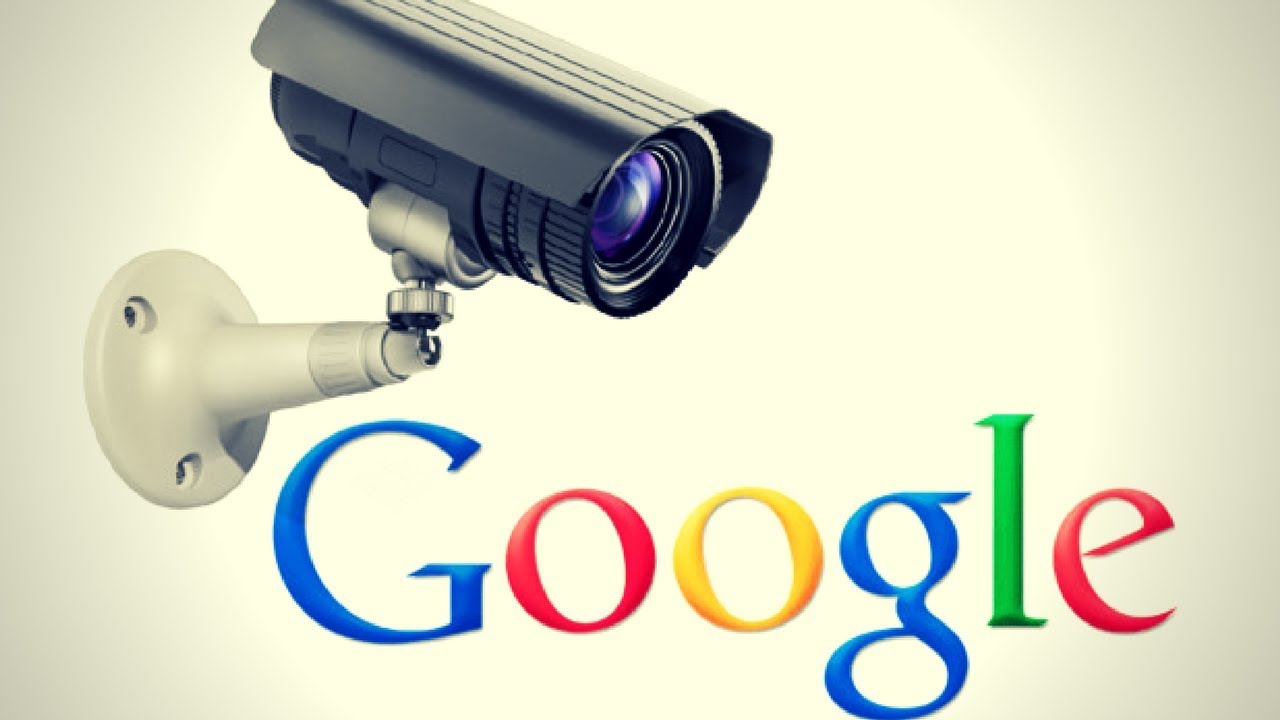
Google knows every website you go, who your friends are (via Contacts) and maybe even where you travel to (via Google Maps).

OPINION: After years of warnings about being careful with your personal data online, people are finally waking up to how much tech companies know about them.

While Facebook has taken the brunt of the recent criticism, Google also has a vast amount of data about you.

Internet users do more than three billion searches on Google every day and all the data is kept and used to help them sell more ads.


READ MORE: It’s not just Facebook – companies from Trade Me to the bank use your data

While it’s easy to find out what data Google has on you, it’s hard to escape. Even if you delete your activity, the company still keeps some basic personal data.

And the more you use Google products, the more useful they become. For example, you can set a work and home address in Google Maps so when you search for a destination it can tell you how far it is from work or home. But if you do that you’re giving them key personal information which can also be used by other Google apps.

Also, Google’s suite of services makes it inconvenient to leave. Gmail, Maps, Docs, Chrome Sheets, and Drive are all great products, but get even better when used in conjunction with each other.

So what are your options?

First, take a look at what Google knows about you (visit myactivity.google.com) or download it (takeout.google.com). If you’re happy with it having that data then you can keep on using Google apps for free and in exchange allow it to track and keep your information.

The other option is to lock down some of the settings, for example blocking your location.
Your final option is to leave Google. You can delete all the data Google knows about you and start using other apps.

Start by using DuckDuckGo, a search engine that doesn’t track you online. For navigating around town you could download the Navmii app, and maybe look at Firefox to replace Chrome as a web browser. Instead of Gmail, try Kolab Now or FastMail and for documents you could try Microsoft Office or Zoho Docs.

It takes a buffet of apps to replace Google, but it is possible to leave the company and stop it collecting and using your data.

Play Store Android Apps Tracking Kids’ Online Activity Like Facebook Scandal

Google Play is full of Android apps that track kids’ online activity, thus violating the U.S. privacy laws such as COPPA, claims a survey from a team of university researchers and computer scientists, according to Gizmodo. The latest finding could be another big revelation related to user privacy following Facebook’s Cambridge Analytica scandal.

The team, in its research paper, concluded that out of the 5,855 apps in the Play Store which claim to be designed for families, 28% “accessed sensitive data protected by Android permissions” and 73% of the Android apps “transmitted sensitive data over the internet.”

Although the survey revealed that merely collecting the data does not amount to breaking any law under the COPPA (Children’s Online Privacy Protection Act), there is a federal law requiring developers to limit tracking kids’ online activity for kids under the age of 13. Also, none of these Android apps attained verifiable parental consent as required under the law since their automated tool was enough to activate them.
Further, the survey revealed that there were approximately 256 apps that collected sensitive geolocation data, 107 shared the device owner’s email address and 10 of them shared phone numbers. About 1100 apps shared persistent identifiers that could be utilized in behavioral advertising techniques, something that is debarred for use on kids by COPPA. Then, there were 2,281 apps transmitting Android Advertising IDs that Google directs the developers and SDKs to use as the sole persistent method of ad tracking. So some apps were even in violation of Google’s privacy policy.
Though the study reveals the upsetting situation in the app market, unfortunately, there is no legal action that can be initiated under the current terms of COPPA. While the Android apps tracking kids’ online activity are unethical in their own way, the bigger problem might be with COPPA, which is not stringent enough to check on these possible violations. And, apps are taking advantage of these ambiguities present in these laws.

For instance, language app Duolingo, which is also in the list of violators, notes that since it is marketed at the general audience, it thus does not fall under COPPA. Duolingo sends information to third parties, but claims that those parties are merely using it for bug fixing and app crashes, notes SlashGear.

The reputation of Android apps has always been questioned when it comes to security. A recent analysis of free Android apps revealed that the developers are leaving behind the keys embedded in applications in some cases because the software developer kits install them by default. Will Dormann, software vulnerability analyst at the CERT Coordination Center, told the BSides conference in San Francisco that he tested around 1.8 million Android apps only to discover gaffes in operational security such as PGP Keys, VPN codes and hardcoded admin passwords, which were readily available.
Suggesting that he only scanned free apps, Dormann said, “Paid apps have similar issues I’m sure but the problem is I’ve downloaded 1.8 million apps and even if they are only 99 cents apiece I’m not paying that much.”
Overall, Dorrmann found some 20,000 apps with insecure keys that were built in and were available along with the popular code such as Samsung’s smart home app. The researcher suggested that leaving passwords in the apps is lax behavior on the part of the developer, but some are better than others in muddying the practice.
App permission has not been such a hot topic of discussion until now. After the Facebook fiasco, people have become cagey about the apps that want them to reveal a little too much about themselves. During Mark Zuckerberg’s Congressional testimony last week, two representatives asked if Facebook might be using the microphones in the smartphones to listen to conversations and use that information to target users with specific ads.
To this Zuckerberg replied that his company does not access the audio. However, he quickly said that they have access to the audio when people record video on their phone for Facebook. “I think that is pretty clear. But I just wanted to make sure I was exhaustive there,” Zuckerberg added.
It is obvious that the mobile apps, irrespective of the platform, hog a substantial amount of data with every interaction by accessing the microphone, cameras, camera roll, location services, contacts, calendars, motion sensors, social media accounts and speech recognition. While some apps need certain information to provide the service, such as ride-hailing apps cannot provide the service without location information, many apps just track data for the sake of doing so.
Ish Shabazz, an independent iOS developer, says that while there are legitimate and non-invasive ways to collect and use data, one who is nefarious could use the info in a lot of non-helpful ways, according to Wired.

Facebook employees are in disbelief | Mark Zuckerberg Distrust on his employee

Facebook CEO Mark Zuckerberg has since said the Bosworth memo was “one that most people at Facebook including myself disagreed with strongly,” describing his longtime deputy as a “talented leader who says many trusted things.”

Bosworth, a vice president at Facebook who’s known as Boz, wrote in June 2016, that hacking on face book for the improvement of company is good but in case of terrorism of Leaking of data we will not bear it.

“Dozens of employees criticized the unknown leakers at the company. ‘Leakers, please resign instead of sabotaging the company,’ one wrote in a comment under Bosworth’s post. Wrote another: ‘How fucking terrible that some irresponsible jerk decided he or she had some god complex that jeopardizes our inner culture and something that makes Facebook great?'”
Here’s where the discussion gets conspiratorial:

“Another theory floated by multiple employees is that Facebook has been targeted by spies or state-level actors hoping to embarrass the company. ‘Keep in mind that leakers could be intentionally placed bad actors, not just employees making a one-off bad decision,’ one wrote. ‘Thinking adversarially, if I wanted info from Facebook, the easiest path would be to get people hired into low-level employee or contract roles.’ Another wrote: ‘Imagine that some percentage of leakers are spies for governments. A call to morals or problems of performance would be irrelevant in this case, because dissolution is the intent of those actors. If that’s our threat — and maybe it is, given the current political situation? — then is it even possible to build a system that defaults to open, but that is able to resist these bad actors (or do we need to redesign the system?)'”
It’s hard to tell how most Facebook employees — not just the loudest — feel about Bosworth’s positions, and it’s possible that these threads were taken out of context. That’s Bosworth’s explanation for what was said in the memo, which BuzzFeed published in full.